Housing needs of people who have Down’s syndrome
Down Syndrome Act 2022 Best Practice and Resources
Last updated: January 2026

In this regularly updated resource, the Down’s Syndrome Association has selected a range of best practice examples and resources related to the housing needs of people who have Down’s syndrome.
It is intended to supplement the Down Syndrome Act statutory guidance annex once it is published by the Department of Health and Social Care (DHSC).
These best practice examples and resources will be of use to housing organisations and providers, as well as local authority professionals (relevant authorities) when supporting people who have Down’s syndrome in relation to their legislative duties as described within the Down Syndrome Act and the Down Syndrome Act Statutory Guidance.
This information will also be useful to individuals who have Down’s syndrome and families/carers. We will keep this webpage regularly updated with the very latest information, case studies and best resources related to supporting the housing needs of people who have Down’s syndrome.
If you are aware of other best practice examples, resources or case studies please do let us know about them by emailing policy@downs-syndrome.org.uk.
Providing access to good-quality, suitable housing for people with Down syndrome
The Down’s Syndrome Association provides extensive information and support relating to securing suitable housing for people who have Down’s syndrome.
This information includes information on the legislation that supports individuals to make choices about where they live, as well as different models of housing with case study examples.
The DSA Easy Read housing resources include:
- Choosing Where to Live
- Choosing Who To Live With
- Getting Ready To Move Out
- Getting Help In Your Home
- Becoming More Independent
- Looking After Your Home
- Looking After Your Money
- Making Choices
- Paying Bills
- Staying Safe
- When There Is A Problem
The DSA also provides additional information for parents and carers about Supported Living, as well as a What is supported living? resource.
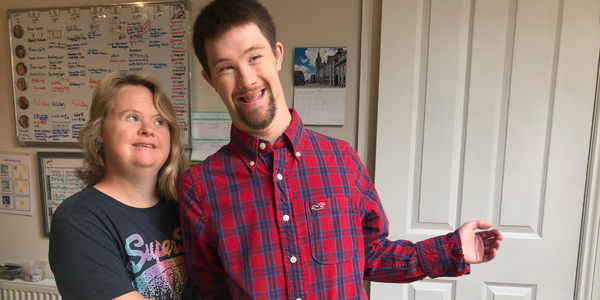
Below are some examples of good practice when it comes to housing provision from the Down’s Syndrome Association.
Case Study: a planned transition from family home to Home Ownership for People with Long-term Disabilities (HOLD)
A young woman in her late twenties had lived with her mum all her life.
After building up her independence through day services and overnight breaks, the family decided it was time to look at a long-term housing solution. With support from MySafeHome, they found a small bungalow near her mum’s house. A housing association purchased it jointly, and the woman took out a mortgage on a 40 percent share, supported by SMI.
She now lives there with support from a care team she helped to choose. Her mum says: ‘She’s still close by, but it’s her own space. She’s really proud of it’.

Case Study: a new-build apartment with family support
A young man who has Down’s syndrome and mental health needs wanted to move out of supported living, which had not worked well for him.
His family helped him buy a 25 percent share in a new-build flat with a housing association. They contributed a £10,000 deposit and found a broker who secured a mortgage based on PIP and UC income. His monthly mortgage and rent are covered through benefits.
The family arranged care separately and set up systems to help manage bills and appointments.
His mum said: ‘After such a hard few years, he’s smiling again. It’s his space; he has pride and privacy.’

Case Study: leasing to a charity landlord
One family bought a flat for their daughter, who was ready for more independence but had struggled in shared supported living.
They leased the property to a national charity that became the legal landlord. The charity issued a tenancy to their daughter at a rent aligned with local market rates. Because the arrangement met DWP criteria and was overseen by a registered provider, the Universal Credit housing element covered the full rent.
The family stepped back from day-to-day management, and the daughter now receives support from a team of her choosing. The family is in the process of transferring the property into a trust to secure it for the future.
‘We wanted her to have security without us needing to manage everything forever. This gave her a real home – and us peace of mind.’
Case Study: supporting families through the closure of a residential service
When the residential service at Furlong Close in Wiltshire was scheduled for closure by HFT, a group of 23 families sought support from the Down’s Syndrome Association.
We worked closely with them as a collective, helping them understand their rights under the Care Act, advising on how to approach Wiltshire Council, and offering guidance on what good commissioning and transition planning should look like.
We also introduced the families to a specialist housing developer and supported early discussions between the developer, commissioners and providers. This collaboration resulted in the developer purchasing part of the Furlong Close site from HFT, creating the opportunity to build a new state of the art supported living development on the same land.
This meant residents could remain in their local community, keep their friendships and routines, and move into modern, self-contained accommodation that promoted choice and independence.
The outcome demonstrated how families, providers and commissioners can work together to create positive solutions even in the face of difficult service closures.

Case Study: highlighting the role of needs assessments in housing strategies
The Local Government Association (LGA) has published a case study of a strategic assessment of the accommodation with support needs for people with a learning disability, autism and mental health conditions, with applicable learnings for supporting people with Down syndrome.
Ensuring people who have Down’s syndrome have choice and control over housing
Individual Service Funds for people locally are as the next best choice after Direct Payments in terms of choice and control. The Down’s Syndrome Association has published several Individual Service Fund (ISF) case studies, which show how care can be used innovatively and in a person-centred way for those who, for whatever reason, are not eligible for a Direct Payment.
LGA and the Association of Directors of Adult Social Services, as partners in care and health, have published a guide to inform councils about how to develop a housing with support pipeline for people with a learning disability and autistic people, which includes case studies from local councils.

Case Study: supporting people who have Down syndrome to explore housing options
A young person who has Down’s syndrome said:
‘When I was a student at the Orpheus Centre college, we were taken on trips out to visit alumni students who were either living in shared or independent accommodation.
The students said they liked their houses and the areas they lived in, and they had jobs in the area too. We could ask them if they had friends or went to social activities. I found this really helpful. They told us about the support they had to go out and about, and keep the house clean.’
Paying these visits while at residential college helped Orpheus students think about where they might live in the next chapter of their lives, encouraging questions about both the challenges and the benefits of moving into their own or shared place.
Providing accessible information on housing for people who have Down’s syndrome
Learning Disability England has published Where you want to live: a housing guide, in easy read format, to support people with learning disabilities, which can include those with Down syndrome, to understand the different options, plan and make housing decisions.
DSA provides lots of information about housing options for people who have Down’s syndrome and their families, including their rights under the Care Act. Much of it is in easy read format.