
 When I think back to my conservatoire training in musical theatre, I see the dancer I used to be. Everything was about intensity — high-impact warm-ups, deep stretches, pushing through the pain because that’s what made you stronger. Choreography was complex and performative, always chasing precision, stamina, and the next level of perfection.
That version of me carried into my early teaching too. I guided dancers through routines and preparation in the same way I’d been trained: pushing them to be their best, demanding high standards, and focusing on results. It was always from a place of care and belief in their potential, but my methods came straight from the world I had been shaped in.
It wasn’t until my BA (Hons) in Dance Performance and Teaching that my perspective began to shift. This course aligned much more closely with the teacher I am today. I learned to take a holistic approach — to check in with how participants were feeling before setting the tone of a session, and to think about the individual rather than just the outcome. During this time, I also began teaching people who have Down’s syndrome for the first time. This shaped my teaching even further.
Rethinking What the Body Needs
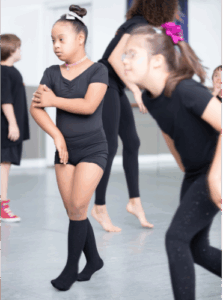 At first, I didn’t fully appreciate the physical challenges that some people who have Down’s syndrome experience and how they might affect dance. But with experience, research, and reflection, I realised there were important things I had to consider.
The higher risk of cervical instability meant that certain movements I once took for granted — like deep neck rolls or sudden head whips — could no longer be used casually. I had to adjust warm-ups and exercises from a place of safety, choosing mobility and strengthening movements that prepared the body without putting participants at risk.
Hypermobility was another consideration. Flexible joints can give the illusion of ease, but in reality, they often need support to prevent injury. Where I used to encourage dancers to push deeper into their flexibility, I now focus on stability: strengthening the muscles around the joints, building control, and finding safe ranges of motion.
 Balance and coordination also became a big part of my learning curve. I noticed that weight shifts, directional changes, and combining movements sometimes needed more time and clarity. To support this, I began using rhythm as an anchor, breaking things down into smaller parts, and often bringing in visuals or props to show the pathway of a movement. For example, I might suggest stepping around an object or use a visual to show that a movement takes someone away from a point and then back to it again, creating a clear sense of travel and return. These adjustments gave participants another way to understand movement, not just copy it, and helped make transitions steadier and more confident.
Low muscle tone also brought its own challenges. It can affect posture, stamina, and balance, meaning a session might need to move at a different pace or allow space for breaks. I began to see the value of repetition not as “doing the same thing again” but as giving the body time to learn, adapt, and grow stronger.
And perhaps the most important lesson: every participant is different. Strength, coordination, and mobility vary widely, which means choreography can’t be one-size-fits-all. Instead, it has to be layered, adaptable, and open to individual interpretation.
How My Teaching Has Changed
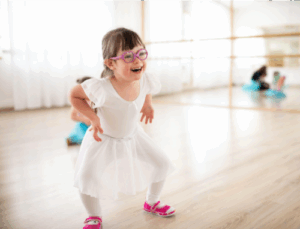 The way I teach now looks completely different to the way I taught during my conservatoire years. I begin every session by checking in with participants, finding out how they feel physically and emotionally before deciding where we’ll go together. The plan I bring into the session is never set in stone — I’ve learned to be responsive and adapt in real time, following the energy and needs of the group rather than forcing a structure that doesn’t fit.
When teaching choreography, I build it gradually. Instead of sharing long, complex phrases all at once, I break movements into smaller parts, giving time for processing and mastery before moving on. I’ve come to appreciate how repetition builds not only skill, but also confidence.
Communication has also become a more creative process. Sometimes words aren’t enough, so I rely on demonstration, rhythm, gesture, or visual cues to get an idea across. At times, I’ve drawn on self-taught Makaton to support understanding, and I’m always open to finding whatever method works best for the participant in front of me.
I still offer adaptations when I choreograph, but I’ve learned not to assume they’ll be taken. More often than not, participants surprise me by choosing the full version of a step. And that has been one of the most powerful lessons of all: people want to be challenged, to rise to the movement, to see themselves as dancers in the fullest sense.
Early on, I used to hold back — worried that my own engagement in the movement might set an expectation that wasn’t fair or safe. But I now understand that participants want to see me fully engaged. Seeing how I move gives them a reference and inspiration, while still allowing them to approach the steps in the way that works best for them — whether that’s the full version, an adapted version, or something in between.
Rediscovering Joy
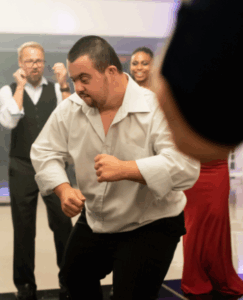 Through this process, I’ve been given back something I didn’t realise I had lost: the joy of dance for its own sake. In the past, I was consumed by perfection — the deepest stretch, the highest kick, the sharpest line. But working with people who have Down’s syndrome has reminded me that perfection is subjective. It’s not what makes someone a dancer, and it certainly doesn’t make one person more worthy than another.
Dance is about joy, expression, and connection. It’s about moving because it feels good, because it tells a story, because it brings people together. My participants have reminded me that letting go of expectations doesn’t mean lowering standards — it means creating space for everyone to shine in their own way.
And in helping them shine, I’ve found myself shining too.
By Abbiegale Blake, WorkFit Co-ordinator and Freelance Dance Artist with DanceSydrome
October 2025