
A team from ARU (Anglia Ruskin University) are running a study designed to see whether a simple and safe form of exercise, such as walking, improves physical, brain and ageing health for adults with Down syndrome.
Please note that the DSA supports the aims of this study but any text describing/advertising the study is provided by the research team.
‘Walking for Health’ is an outdoor intervention designed to see whether a simple and safe form of exercise such as walking, improves physical, brain and ageing health for adults with Down syndrome.
We are looking for adults with Down syndrome (older than 18 years) with the following characteristics to take part in this study.
- No underlying health conditions that will be made worse from participation in physical activity.
- Have access to a personal laptop/ tablet and mobile device.
- Can speak and write in simple English.
- Adequate neighbourhood walkability.
The study will include a 12-week outdoor walking intervention, for 20 to 35 minutes, three or four times a week.
The walks may get progressively harder at weeks three, six and nine, by increasing the length and speed. This will ensure that the participants build fitness in a safe way.
To see whether this kind of exercise intervention improves health we will also conduct some short and simple-to-follow tests at weeks one, six and 12.
These tests will check for:
- physical fitness
- brain health (decision making, attention and memory)
- ageing health.
Physical fitness:
The first test will be a ‘six-minute-walk-test’ where participants will be asked to walk as far as they can in six minutes. This will test cardio-respiratory fitness.
The second physical test is the ‘talk-test’. This test will help determine the participants walking pace during the main study. Participants will be asked to start walking for one minute. If the participant can comfortably sing a song during their walk, they will be asked to walk faster. The test will be stopped when the participant can no longer clearly or loudly sing a song. (This test will be done once at the start of the study).
Brain Tasks:
On a separate day, we will ask participants to use their laptop/tablet to complete three online brain tasks that will test the participants decision making, attention, and memory. Each task will take between five and seven minutes to complete and are designed to be fun and interactive.
Colour game: participants are asked to choose the colour of a word rather than the spelling of the word.
Number game: participants will be asked to press the spacebar on their keyboard for every number that appears on their screen apart from the number 3.
Memory game: participants will be asked to remember a pattern of flashing blocks. They will be asked to watch the blocks light up and then click them in the order they see them.
Saliva sample
A saliva kit will be sent to your home address, and we will ask participants to collect a saliva sample. This will test the participants aging health.
Click for more information about this test and saliva kit.
The findings from this study will help inform inclusive and effective exercise programmes, clinical and support services, and guide organisations in promoting lifelong activity for people with Down syndrome.
The study has ethical approval from the Faculty of Science and Engineering research ethics panel within Anglia Ruskin University, Cambridge.
Further information
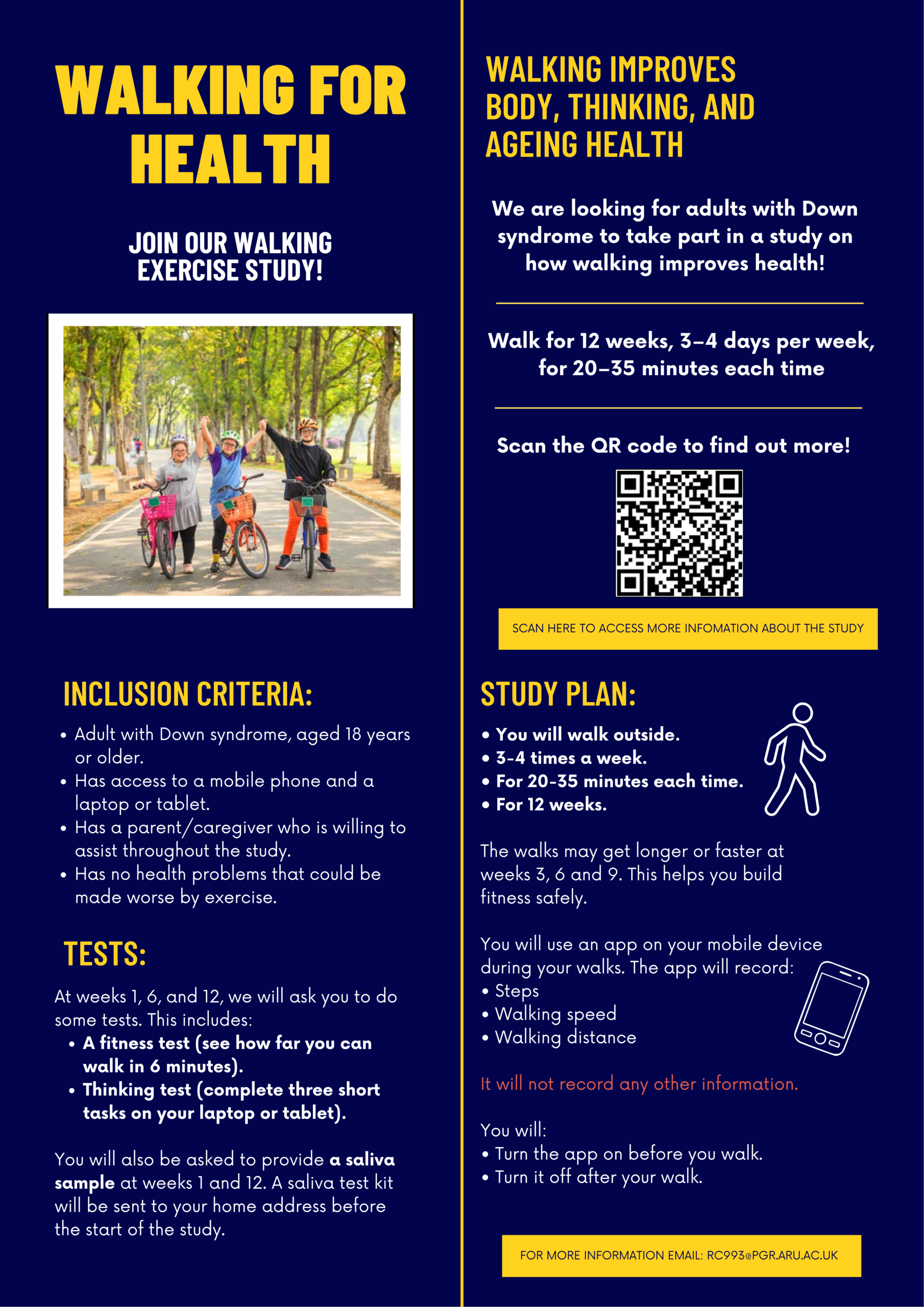
To take part visit the project website here or scan the QR code on the flyer.
Research team
Ruby Elizabeth Cain:
Ruby is a first year PhD student specializing in exercise interventions for the Down syndrome community. She has worked as a special educational needs (SEN) swimming teacher and is an on-going “Para coach” for an elite swimming club. Her primary research goal is to expand her knowledge on how to effectively incorporate sport and exercise into the lives of people with special educational needs, particularly those with Down syndrome, to enhance physical, mental, and social well-being.
Prof. Dan Gordon:
Dan is an exercise physiologist with a passion and interest in the factors which limit human athletic performance. Dan has experience of supporting athletes in a vast array of sports including track and field, cycling, football and rugby. He’s represented Great Britain in three sports, is a Paralympian and a World Record holder. His previous one of kind research for the Down syndrome community, ‘MinDSets’, linked exercise to increased cognition for people with Down syndrome.
Dr. Matthew Jewiss:
Matt was awarded his PhD, MSc, BSc and Fellowship of the HEA (FHEA) from the University of Chichester. His research interests are performance under pressure in a variety of performance domains, e.g., sport, education, aviation and the emergency services. He also contributed to the one of kind research for the Down syndrome community, ‘MinDsets’.
Dr. Don Keiller:
Don completed his MA, in Natural Sciences and PhD, in biochemistry, at Cambridge University, Since then he has worked at Leicester, Sheffield and Anglia Ruskin University, supervising several PhD students. Having competed in university level sport, he has focused this interest on researching the molecular genetics of exercise performance. He is keen to use this expertise to help improve the understanding the interactions of exercise and genetics in improving cognitive function and life quality of those with Down Syndrome.