
A team from the University of York, in collaboration with the University of Manchester and Down Syndrome Education International, are undertaking a trial of a new app designed to encourage babies who have Down’s syndrome to make more vocal sounds.
Please note that the DSA supports the aims of this study but any text describing/advertising the study is provided by the research team.
 Babies who have Down’s syndrome often make fewer sounds and usually start saying words later than other children. This study is testing a new app, BabblePlay, designed to encourage babies to make more vocal sounds.
When a baby makes a sound, BabblePlay responds by showing colourful, moving shapes on an iPad. If babies enjoy seeing the shapes, they may make more sounds to see more shapes. Over time, this may help support early speech and language development.
This study will explore whether playing with the app for six weeks helps babies with Down syndrome to make sounds not just while using the app, but in everyday life too. We will also look at whether increased baby vocalisations lead to more caregiver talk and support later language development.
Families will take part from their home over several months. Babies will be randomly allocated to either the intervention group, who will use the BabblePlay app for six weeks, or to the control group. All families will complete three home audio recordings at different timepoints and an online language questionnaire 11 months later.
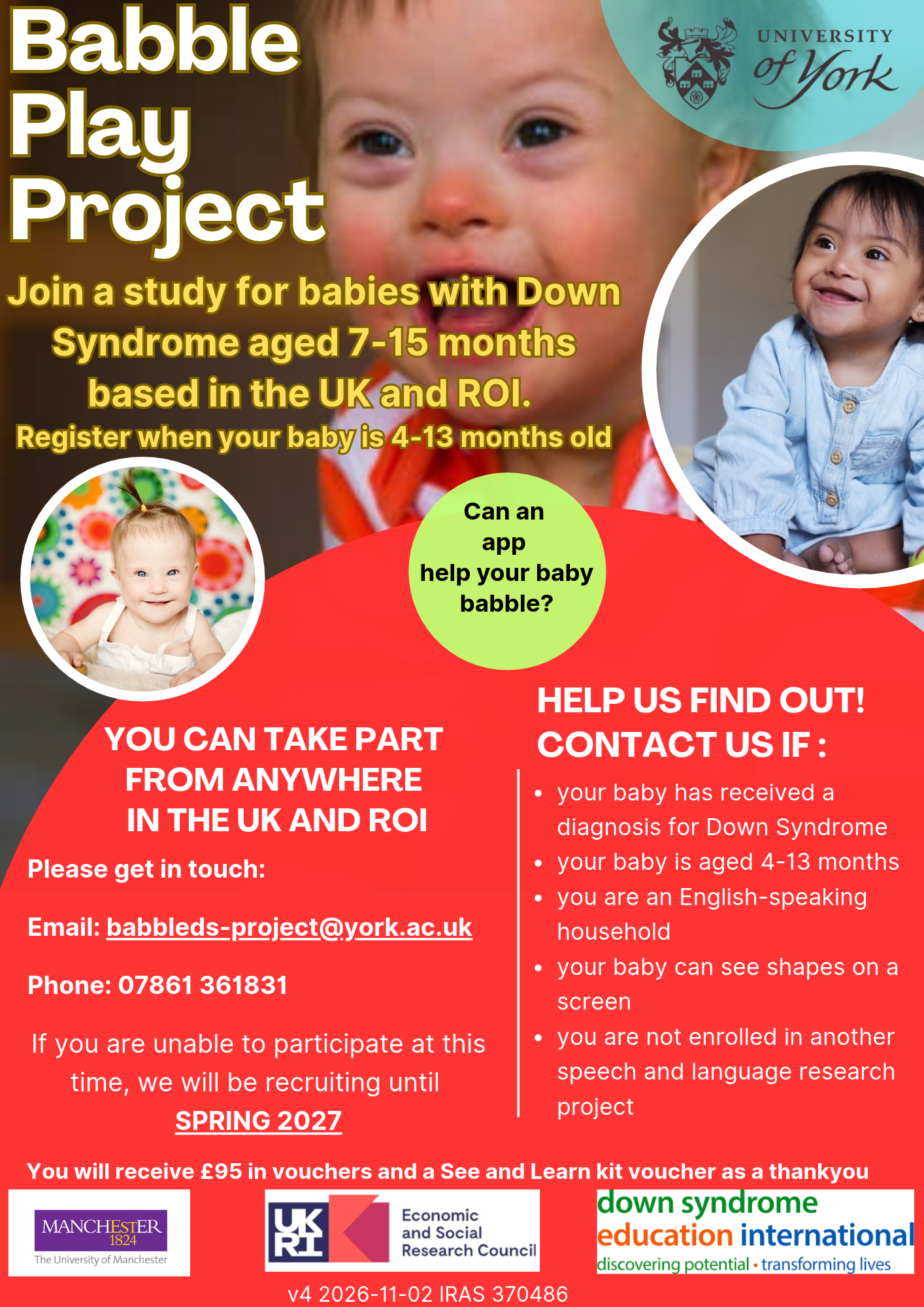
English-speaking families in the UK and Republic of Ireland who have a baby who has Down’s syndrome, aged 7-15 months, may be eligible to take part.
Families can sign-up when their baby is 3-13 months old.
If you’d like to find out more or take part:
- visit our Baby Lab Facebook page
- download the flyer (image above)
- click here to register your interest
- email babbleds-project@york.ac.uk.
About the research team
Tamar is a Professor at the Department of Language and Linguistic Science at the University of York. She got her PhD at the Hebrew University of Jerusalem. Tamar is interested in the ways in which babies shape their own learning by building on what they’ve done before. She is also interested in the ways in which adults speak to children and what children learn from the speech they hear. Tamar has recently started to work with clinicians and charities to test ways of improving language outcomes in baby populations who are at risk of language delay, in particular babies who have Down’s syndrome.
Laura is a Postdoctoral Research Associate at the University of York. She completed her PhD at the University of Manchester and has previously been involved in several projects at the University of Manchester exploring early language development and interventions to support this. Laura is interested in how pre-verbal infants learn from their environment and from early interactions with their caregivers, to develop the necessary skills for later language development. She is also interested in how we can develop and evaluate interventions aimed at supporting language development in those at risk of language delay, including babies who have Down’s syndrome.
Sab is a Research Assistant at the University of York. She has a BA in Psychology and is currently completing an MSc in Research Methods with Education at the University of Manchester. Following completion of her Master’s degree, she will begin a PhD exploring friendships in children who have Down’s syndrome. Sab has been the grant manager for all three of our BabblePlay projects and has extensive experience working with families on research projects.